How to Choose a Zapier Alternative AI Automation Tool in 2026
Your team already runs on WhatsApp, yet you are paying for a separate automation tool to connect the apps around it. Every new Zap adds another subscription, another login, and another place where tasks quietly fall through. Choosing the wrong platform in 2026 means paying twice for work your messaging app could handle.
This article walks through what to compare before you commit: natural language and voice note handling, built-in task assignment and approvals, GPS and attendance tools for field crews, plus pricing, security, and beta status. By the end, you will know whether Tasks.Bot fits your team or whether a different tool does.
What Is Tasks.Bot? AI Automation Without Leaving WhatsApp
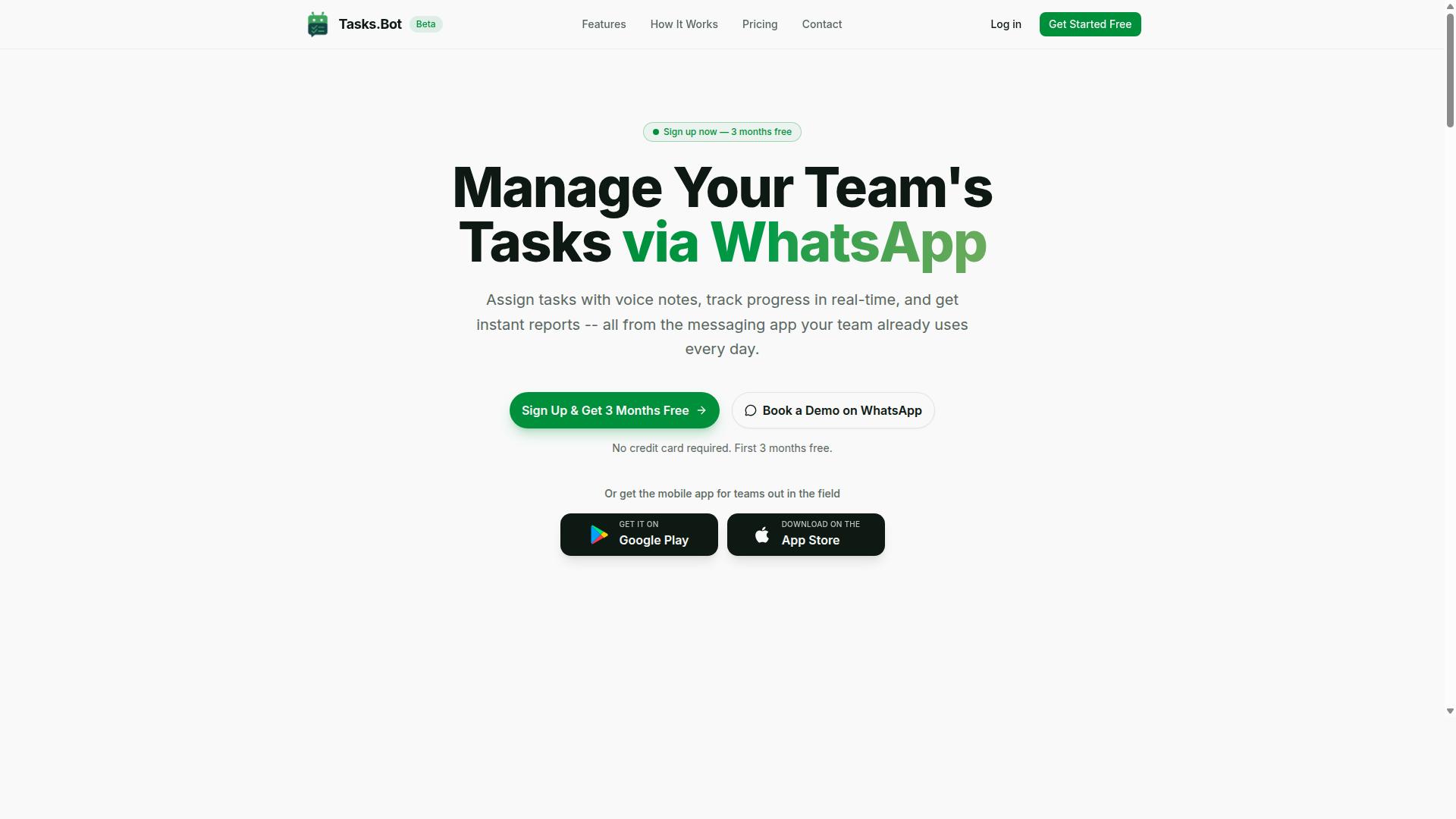
Tasks.Bot is a task management platform that operates entirely within WhatsApp, enabling teams to assign tasks, track progress, and receive reports without leaving the messaging app. For anyone weighing a Zapier alternative AI automation tool in 2026, it represents a different philosophy: instead of connecting dozens of separate apps through trigger-action logic, it turns the tool your team already uses every day into the automation layer itself.
That distinction matters more than it first appears. Most workflow automation platforms assume every team member will create an account, learn a new interface, and check yet another dashboard. Tasks.Bot removes that assumption entirely. No new software to install. No separate logins to manage. If a person can send a WhatsApp message, they can participate in the workflow.
This is where the AI layer does its real work. Tasks.Bot uses AI to understand natural language and voice notes, so creating a task feels like sending a normal message rather than filling out a form. The barrier between thinking of work and assigning it essentially disappears.
For teams spread across offices, job sites, or client locations, Tasks.Bot also offers a mobile app for field teams. This gives workers who are not sitting at a desk a dedicated way to stay connected to the same task flow, while the core experience remains rooted in WhatsApp.
Seen through the lens of the wider automation market, Tasks.Bot sits in an interesting spot. It is not trying to be a full iPaaS platform with REST API orchestration, GraphQL endpoints, or complex data mapping. It is an AI automation tool focused on one high-value outcome: making sure tasks get created, assigned, and completed without friction. For teams whose biggest automation gap is simply getting people to use the system at all, that focus is the point.
It is worth noting that Tasks.Bot is currently in beta and offers a free trial period, so teams can evaluate whether WhatsApp-native task management fits their workflow before committing. For organizations already living in WhatsApp, the appeal is straightforward: automation that meets people where they are, rather than asking them to go somewhere new.
Why Tasks.Bot Is a Smarter Zapier Alternative for WhatsApp-First Teams
For teams that rely on WhatsApp for daily communication, Tasks.Bot offers a more integrated and context-aware alternative to generic automation platforms like Zapier. Zapier is genuinely strong at connecting thousands of apps through trigger-action logic, and for many back-office workflows that approach works well. But its model assumes structured data moving between systems, not conversations happening inside a chat thread.
That gap matters for WhatsApp-first teams. Field crews, service technicians, sales reps, and small operations teams often coordinate entirely through chat. When a task lives in a separate automation platform, someone still has to translate the conversation into a trigger, a webhook, or a multi-step workflow before anything happens.
Tasks.Bot is built for the opposite reality. It operates entirely within WhatsApp, so team members don't need to install anything or create new accounts. There is no separate dashboard to learn and no no-code integration to assemble before the first task gets logged.
The platform uses AI to understand natural language and voice notes for task creation, which means the chat itself becomes the interface. Alongside that, it offers face-verified attendance, live GPS tracking for field staff, and enterprise-grade encryption, with conversations and task data never shared or used for training.
The two sections below look at how that AI interpretation works in practice, and how the built-in automations replace the several-step operations a Zapier-style setup would normally require.
How Tasks.Bot's AI Understands Natural Language and Voice Notes
Tasks.Bot's AI engine parses everyday language and voice messages to automatically create and assign tasks, eliminating the need for structured input.
Voice notes follow the same path. A user records a spoken instruction in WhatsApp, and Tasks.Bot processes it the same way it handles typed text. For field teams working with gloves on, driving between sites, or standing on a ladder, that removes a real barrier to delegation.
The practical effect is speed. Task delegation stops depending on someone remembering to open a tool, fill a form, and pick a dropdown value. It happens in the same thread where the work was discussed, which is where context already lives.
Contrast this with Zapier's trigger-action logic. Zapier needs predefined triggers and actions, and it cannot interpret unstructured natural language on its own. Building a "create a task from a message" workflow typically means chaining steps, mapping data fields, and handling edge cases manually.
Tasks.Bot also ships Android and iOS apps with push notifications, voice capture, and a home screen widget, so the same natural-language input works beyond the WhatsApp window when that suits the user better.
Built-In Automations: Task Assignment, Approvals, and Smart Deadline Reminders
Tasks.Bot includes a suite of built-in automations that handle task assignment, approval workflows, and deadline reminders without any external configuration. There is no workflow builder to wire up and no trigger-action pair to debug when something misfires.
Assignment can follow rules or AI interpretation of the original message. Where a rule is set, the platform applies it consistently across incoming work rather than relying on someone to route each item by hand.
Approvals work as a native step in the task lifecycle. A task can require manager sign-off, and the system sends notifications and escalates when something sits too long. That keeps review from becoming a bottleneck that only surfaces in a weekly meeting.
Smart deadline reminders adapt to task priority and user behavior. Rather than firing the same alert at the same interval for every item, the reminder pattern responds to what the task actually needs. This is the kind of conditional branching that would otherwise mean building a multi-step workflow with filters and paths.
Supporting features round out the picture. Tasks.Bot provides instant reports, tasks on a map, a live day tracker, and shifts, leave, and hours management. Each of these is native to the platform rather than something assembled through API orchestration or a separate iPaaS layer.
For teams weighing a Zapier alternative in 2026, the deciding question is often simpler than a feature comparison. If your work already happens in WhatsApp, Tasks.Bot meets it there, with AI-powered task automation that requires no new accounts, no installation, and no workflow to build first.
Key Features That Set Tasks.Bot Apart
Beyond basic task management, Tasks.Bot offers specialized features for field teams, including live GPS tracking, face-verified attendance, and comprehensive reporting. These capabilities go well beyond what a typical Zapier alternative delivers.
Most AI automation tools focus on connecting apps and moving data between them. That is valuable, but it leaves a gap for businesses that manage people, not just processes.
Tasks.Bot fills that gap by combining task management with workforce tools. It runs through WhatsApp, so teams do not need to learn a new platform or install extra software to get started.
This dual focus on automation and people management is what separates Tasks.Bot from generic workflow automation platforms. The sections below break down exactly how these features work.
Field Team Tools: Live GPS Tracking, Tasks on a Map, and Face-Verified Attendance
Tasks.Bot equips field teams with live GPS tracking, a map view of tasks, and face-verified attendance to ensure accountability and efficiency. Managers can see real-time locations of field staff and tasks on a map, so dispatch decisions are based on where people actually are.
Face-verified attendance adds a layer of trust that spreadsheets and sign-in sheets cannot match. It prevents buddy punching, where one worker clocks in for another. For businesses with distributed teams, this closes a costly loophole.
What makes these tools stand out is how they are delivered. Everything runs inside the WhatsApp interface, which means field workers use an app they already know. There is no separate login, no training session, and no resistance to adoption.
Tasks.Bot also offers Android and iOS apps with push notifications, voice capture, and a home screen widget for teams that prefer a dedicated mobile experience. Voice note task creation lets workers report issues or log updates hands-free.
Compare this to Zapier, which is built for connecting web apps and lacks native field team management features like GPS tracking or attendance verification. Zapier moves data between tools. Tasks.Bot manages the people doing the work.
Reporting, Shifts, Leave, and Payroll-Ready Hours Management
Tasks.Bot simplifies workforce management with instant reports, shift scheduling, leave tracking, and payroll-ready hours calculation. Managers can generate reports on task completion, attendance, and hours worked without digging through multiple systems.
Shift and leave management includes request and approval workflows, so scheduling changes do not get lost in chat threads. Employees submit requests, managers approve or decline, and the system keeps a record.
Hours are tracked accurately and can be exported for payroll processing. This matters most for teams with hourly workers, where every minute of overtime or missed break adds up. A tool that tracks hours alongside tasks removes a manual reconciliation step.
- Instant reports on task completion and attendance
- Shift scheduling with request and approval flows
- Leave tracking that stays connected to daily operations
- Payroll-ready hours that export cleanly for processing
For a Zapier alternative, this is a meaningful differentiator. Zapier can trigger actions when events happen in other apps, but it does not manage shifts, leave, or payroll hours on its own. Tasks.Bot handles those functions natively, which reduces the number of tools a business needs to stitch together.
Pricing and Plans: Simple, Transparent, and Affordable
Tasks.Bot offers a straightforward pricing model with a single 'Full Access' plan, available in both Indian Rupees and US Dollars. There are no confusing tiers, no feature gates, and no surprise charges added later.
The monthly plan costs ₹200 per member per month. For teams that prefer to commit longer, the annual plan is ₹1,200 per year per member, which works out to a saving of 50%, or ₹1,200 per year per member.
Currency selection is built into the platform. A 'Select currency' option lets users choose between the Indian Rupee and the US Dollar, so the same plan can be billed in the currency that suits the account.
New users also get 3 months free, with no credit card required. There is no lock-in pressure either, since the plan can be cancelled at any time.
This flat structure matters because pricing models are one of the biggest hidden costs in workflow automation. Many tools bill by task consumption, which means every trigger, action, and retry inside a multi-step workflow can count toward the bill. As automation scales, those costs climb in ways that are hard to predict.
Tasks.Bot takes a different approach. One plan covers all features, so a team can build more automations, run more event-driven workflows, and add members without watching a usage meter. That predictability is valuable for budgeting, especially when compared to per-task billing that grows with every webhook, API call, or conditional branch a workflow adds.
- Monthly: ₹200 per member per month
- Annual: ₹1,200 per year per member, a 50% saving
- Free trial: 3 months free, no credit card required
- Cancellation: Cancel anytime
- Currency: Indian Rupee or US Dollar
For anyone evaluating a Zapier alternative in 2026, this level of transparency is a real advantage. There are no hidden fees and no tiered feature restrictions, so every member gets the full set of capabilities from day one.
Trust Signals: Security, Beta Status, and Refund Policy
Tasks.Bot is currently in beta, but it already provides a refund policy and employs security measures to protect user data. For anyone weighing a Zapier alternative AI automation tool in 2026, these signals matter as much as feature lists. A tool that handles multi-step workflow logic, webhook payloads, and API orchestration touches sensitive business systems, so buyers should read the trust markers before committing.
The beta label is the first thing to understand. Beta status typically means the product is functional and in active use, while some features may still evolve between releases. That is not a red flag on its own. Many automation platforms ship improvements continuously, and a beta phase often means the team is still refining edge cases in trigger-action logic, error handling, and retry logic.
What matters is how a vendor behaves during that phase. A published refund policy is a concrete signal, because it puts a stated commitment behind the product rather than leaving buyers exposed. Tasks.Bot lists a refund policy in the site footer, which means the terms are visible before purchase instead of buried behind a support request.
Security deserves the same scrutiny. Tasks.Bot states that it employs security measures to protect user data, though it does not publish specific certifications such as SOC 2 compliance, HIPAA, or GDPR attestations. That absence is common among early-stage tools, but it means due diligence falls to the buyer.
For teams comparing a no-code integration platform or a low-code platform, here is a practical checklist for evaluating trust signals in 2026:
- Read the refund policy in the footer before subscribing, and confirm what window applies.
- Ask about encryption for data at rest and in transit, including how credentials and OAuth authentication tokens are stored.
- Request privacy details, such as where data is processed and whether any data residency commitments exist.
- Check the beta roadmap to understand which capabilities are stable and which may still change.
- Contact support directly for specifics on infrastructure, access controls, and incident handling.
If security documentation is not published on the site, the fastest path is to reach out. Tasks.Bot offers a "Book a Demo on WhatsApp" option, which gives prospective buyers a direct way to ask about encryption practices, data handling, and how the refund policy applies to their situation.
Weighing a beta product comes down to fit and risk tolerance. A platform in active development can offer strong value for teams that want early access to newer automation capabilities, provided the refund terms and data practices are acceptable. For regulated industries with strict compliance needs, waiting for published certifications may be the safer route.
For most buyers evaluating workflow automation in 2026, the combination of a stated refund policy, disclosed security measures, and a direct demo channel makes Tasks.Bot a reasonable option to shortlist. Confirm the details that matter to your business, then decide with the terms in hand.
Who Should Choose Tasks.Bot
Tasks.Bot is ideal for teams that already use WhatsApp for communication, especially those with field staff who need task management, attendance tracking, and payroll-ready hours. Instead of asking workers to learn a new app, it meets them in the messaging tool they already open every day.
That distinction matters more than any feature list. A Zapier alternative AI automation tool is only useful if your team actually uses it, and adoption tends to collapse when the interface feels unfamiliar or the workflow demands desktop access.
Tasks.Bot serves a specific audience rather than trying to be everything to everyone. Understanding who fits that profile helps you decide quickly whether it belongs in your 2026 stack.
Field service, construction, maintenance, and delivery teams are the clearest fit. These are mobile-first operations where workers rarely sit at a desk and progress updates arrive in fragments throughout the day.
For these groups, the value is practical:
- Reporting task progress from a phone, without a laptop or a separate login
- Recording attendance as crews move between sites
- Capturing hours in a form that is ready for payroll
- Keeping updates in one thread instead of scattered calls and texts
Each of these tasks happens in the field, in real time, often with gloves on. Tools built for office workflows tend to break down at exactly that moment.
Teams with mobile workers who report progress and attendance from the field get the most out of it. The workflow matches how the job already runs, so there is less training and less resistance.
Adoption is usually the hardest part of any new system. When the tool lives inside WhatsApp, that barrier largely disappears. The site notes that hundreds of teams already use the service, which suggests the approach resonates with operations that tried heavier platforms first.
Zapier, by contrast, is built for a different environment. It shines when office-based teams need to connect many SaaS apps through trigger-action logic, several-step operations, and no-code integration between cloud tools.
That is genuinely valuable work. But it assumes users have browsers open, apps provisioned, and processes that live in software rather than on a job site. A construction crew logging hours does not need API orchestration. It needs a fast way to report what happened today.
The practical test is simple. If your team coordinates through WhatsApp and your records come from the field, Tasks.Bot fits. If your team coordinates through a dozen SaaS dashboards, a general automation platform likely fits better.
For mobile-first operations, the answer in 2026 is straightforward: Tasks.Bot is built for exactly the teams that other automation tools tend to overlook.
Final Verdict: Is Tasks.Bot the Right AI Automation Tool for You in 2026?
If your team lives in WhatsApp and needs a simple, AI-powered way to manage tasks, attendance, and field operations, Tasks.Bot is a compelling alternative to Zapier in 2026. It trades the sprawling connector catalogs of traditional iPaaS platforms for a focused, conversational experience that meets workers where they already spend their day.
The core strength is native WhatsApp integration. Instead of asking field staff to learn a new dashboard, Tasks.Bot turns the chat app they already use into the interface for assigning work, logging updates, and confirming completion.
Layered on top is AI natural language processing. Team members can phrase requests and status updates the way they normally speak, which lowers the training burden that often stalls workflow automation rollouts.
Tasks.Bot also ships with built-in automations and dedicated field team tools. For managers tracking attendance, task progress, and on-ground activity, that combination covers the everyday operational loop without requiring a separate no-code integration project.
Pricing is described as transparent, which matters in a category where per-task billing and subscription tiers can be hard to forecast. Buyers comparing a Zapier alternative in 2026 should weigh that clarity alongside scalability, concurrency, and the error handling guarantees they need.
Where Tasks.Bot differs from a full low-code platform is breadth. It does not attempt to match Zapier's connector count, and readers hunting for deep API orchestration, GraphQL support, OAuth authentication flows, or conditional branching across dozens of SaaS apps may still need a classic iPaaS. Tasks.Bot is still in beta, so some advanced integrations are not yet available.
The honest verdict depends on fit:
- Choose Tasks.Bot if your operations run through WhatsApp and you want AI-assisted task and attendance management without a heavy setup.
- Look elsewhere if you need hundreds of connectors, complex multi-step workflow logic, or mature enterprise compliance certifications.
For teams in the first group, the tradeoff is worthwhile. The tool solves a specific, high-friction problem well rather than spreading itself thin across every possible integration.
The best way to judge it is to see it working with your own workflows. You can book a demo on WhatsApp to walk through how Tasks.Bot handles your tasks, attendance, and field operations.
For further inquiries, reach the team by phone at +91 97143 42522 or by email at [email protected].
Frequently Asked Questions
Do I need to install new software or create accounts for my team to use Tasks.Bot?
No. Tasks.Bot operates entirely within WhatsApp, so team members don't need to install anything or create new accounts - they simply use the messaging app they already have. A mobile app is also available for field teams who need it. This makes onboarding much faster than tools that require every team member to adopt a new platform.
How does Tasks.Bot use AI to make task management easier?
Tasks.Bot uses AI to understand natural language and voice notes, so you can create tasks just by sending a message or voice note in WhatsApp. From there, it supports automatic task assignment, smart deadline reminders, approvals and automations, and instant reports. This means less manual data entry and more of your team's work happening right where they already communicate.
What does Tasks.Bot cost, and is everything included?
Tasks.Bot offers a single 'Full Access' plan with all features included - there are no feature tiers to compare. Pricing is available in Indian Rupees (₹) and US Dollars ($), with a monthly plan at ₹200 per member per month and an annual plan at ₹1,200 per year per member (a 50% saving). You can book a demo on WhatsApp to see it in action before deciding.
Is Tasks.Bot suitable for teams with field staff?
Yes. Tasks.Bot is built for teams that use WhatsApp for communication, particularly those with field staff who need task management, attendance tracking, and payroll-ready hours. Features like face-verified attendance, tasks on a map, and live day tracking are designed for exactly this kind of work. Hundreds of teams are already using the service.
Is Tasks.Bot available in my country?
Tasks.Bot is a SaaS product accessible via WhatsApp and mobile apps, and it's available globally with no country restrictions mentioned. As long as your team uses WhatsApp, you can use Tasks.Bot. The service is currently in beta, and the website includes a refund policy in the footer if you want to review the terms first.
How do I get started or ask questions before choosing a tool?
You can book a demo directly on WhatsApp through the Tasks.Bot website, which lets you see the tool working in the same environment your team would use it. For any questions, you can reach the team at [email protected] or +91 97143 42522. Trying the demo first is a practical way to compare it against other automation tools before committing.
Recommended Resources: