Who's the Best for Pay-Per-Study Pricing: PICOM365 vs Medicai
Your hospital or imaging center is evaluating pay-per-study pricing between PICOM365 and Medicai, and the difference in total spend depends on how many studies you send each month. Many platforms charge extra storage fees once volume spikes, while others bundle viewer access and sharing at no added cost.
By the end of this article you will see exactly how each platform structures its per-study fee, what storage and sharing limits apply, and which option produces the lower monthly bill for a typical 500-study caseload.
Quick Verdict: Pay-Per-Study Pricing
Pay-per-study billing structures charge radiology practices for each individual imaging study processed rather than a fixed monthly subscription. This model creates several drawbacks that radiology practices should consider before committing.
Unpredictable monthly costs rank as the primary concern. When patient volumes fluctuate, expenses can swing dramatically from month to month, making financial planning difficult for practice managers.
Lack of included storage represents another limitation. Each study processed may incur additional fees for long-term retention, adding hidden costs beyond the base per-study rate.
Price scaling during high-volume months creates further complications. Practices processing larger numbers of studies often face increased per-study rates as volumes exceed baseline thresholds.
- Typical radiology practices handle 500 monthly studies during slower periods.
- Busier practices regularly process 1000 to 2000 studies each month.
- Peak periods can push volumes well beyond these baseline figures.
Pure pay-per-study models may work for practices with steady volumes and minimal storage needs. However, most radiology departments benefit from platforms that combine flexible pricing with comprehensive infrastructure support. Medicai processes over 1M studies annually across its platform, demonstrating the capacity to handle varying practice volumes without the cost volatility associated with traditional per-study billing structures.
At a glance: how Medicai compares to PICOM365 on the features that matter most.
| Feature | Medicai | PICOM365 |
|---|---|---|
| Pay-Per-Study Pricing | ✗ | $3 Standard Study |
What Is Medicai?
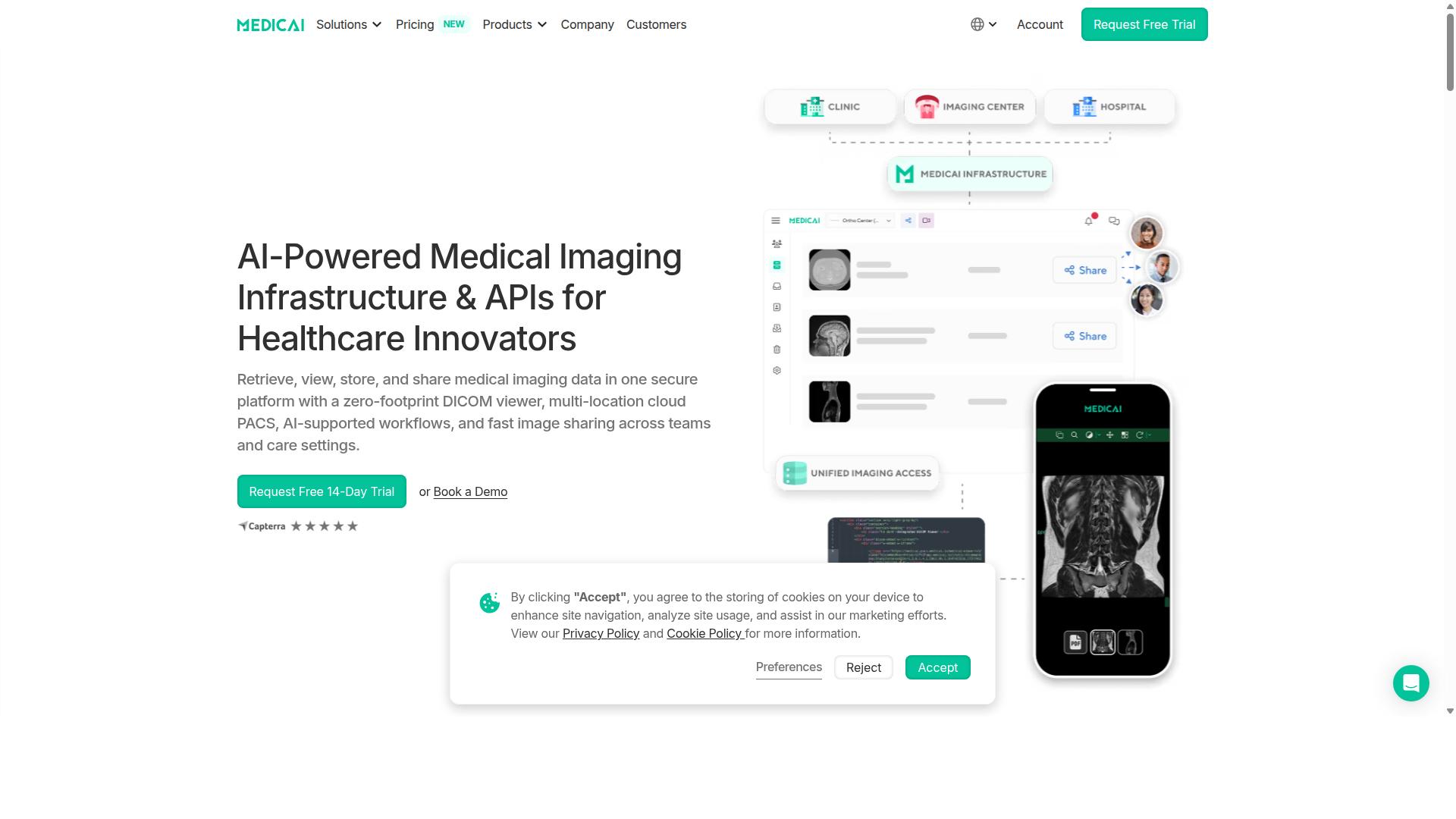
Medicai operates as a cloud-based medical imaging platform designed for healthcare providers handling DICOM data.
The platform brings together several essential functions in one place. Healthcare teams can retrieve, view, store, and share medical imaging through a single secure environment. A zero-footprint DICOM viewer eliminates the need for local software installation while maintaining full diagnostic capabilities.
Scale indicators show consistent adoption across health systems. The platform transacts over 1 million studies each year and maintains storage for 1.7 million studies. These numbers reflect growing reliance on cloud-based infrastructure for radiology workflows.
Medicai delivers Imaging Infrastructure as a Service. This approach supports multi-location cloud PACS deployments while enabling interoperability across different care settings. AI-supported workflows help streamline routine tasks without replacing clinical judgment.
Fast image sharing across teams remains central to the design. Providers can exchange studies between locations without traditional physical media or complex network configurations. This supports both teleradiology arrangements and internal consultation needs.
What Is PICOM365?
Picom365 is a cloud-based PACS solution marketed to radiology practices seeking study-based billing options. It operates as a cloud PACS platform that uses pay-per-study pricing to match costs with actual imaging volume. This approach appeals to groups that prefer to avoid fixed subscription fees.
Many diagnostic imaging centers use this model to manage expenses during periods of fluctuating demand. The platform supports common radiology workflows including image archive storage and basic DICOM viewer access. Cloud delivery allows remote viewing without on-premises hardware maintenance.
Pay-per-study pricing removes the need for large upfront investments or long-term contracts. Instead, practices pay only when they process a study. This structure can align expenses with revenue in teleradiology and multi-site operations.
Medical imaging teams often evaluate such solutions alongside other radiology SaaS options. Key considerations include integration with existing RIS or EMR systems, support for HL7 and FHIR standards, and compliance with HIPAA or GDPR requirements. These factors influence total cost of ownership and long-term scalability.
Before selecting any platform, radiology leaders review hidden fees such as overage charges or add-on services. They also assess uptime reliability and the quality of vendor support. These details determine whether a study-based billing model truly reduces costs or simply shifts them elsewhere.
Features Compared
First sentence: Direct feature comparisons reveal how each platform handles core radiology workflow requirements.
Storage capacity, image sharing capabilities, and security protocols form the foundation of effective radiology operations. These elements influence daily productivity and long-term cost management in medical imaging environments.
Pay-per-study pricing models affect how practices scale their imaging operations over time. Understanding the differences becomes essential when evaluating platforms for sustained clinical use.
Storage & Scalability
First sentence: Storage capacity and scalability determine how platforms accommodate growing imaging volumes over time.
Medicai offers tiered storage options through its Cloud PACS system, with plans starting at 500 GB for Starter users and reaching 2 TB for Standard subscribers. Monthly billing provides flexibility that aligns with variable imaging volumes in radiology practices.
The platform includes Vendor Neutral Archive capabilities along with Backup and Disaster Recovery services. These features support long-term archive growth without the limitations often associated with study-based billing approaches.
General pay-per-study models may restrict archive expansion when imaging volumes increase unexpectedly. Practices need storage solutions that scale predictably with clinical demand rather than billing constraints.
Image Sharing & Collaboration
First sentence: Image sharing features enable radiologists and referring physicians to collaborate across locations without physical media.
Medicai provides Medical Image Exchange and Patient Case Management tools that facilitate multi-location collaboration. These capabilities support teleradiology workflows and enable specialists to review cases from different facilities.
The platform handles over 1M studies processed annually with 10,000 active doctors using the system. DICOM Viewer access supports both desktop and mobile environments for flexible review options.
PICOM365 offers general image sharing capabilities typical of pay-per-study platforms. These usually support basic transmission between locations but may lack the structured case management features needed for complex multi-site operations.
Security & Compliance
First sentence: Security protocols and compliance certifications protect patient data across cloud-based imaging platforms.
Medicai maintains HIPAA and GDPR compliance with FDA/CEE cleared viewers available. The platform processes 50M yearly API transactions while following OWASP security guidelines for data protection.
Microsoft Azure partnership provides enterprise-grade infrastructure for medical imaging operations. These certifications and partnerships address the compliance requirements common in healthcare environments.
PICOM365 follows general compliance expectations typical of pay-per-study solutions. Most platforms maintain basic security standards, though specific certification details vary by provider and deployment model.
Pricing Compared
Pricing structures impact both immediate costs and long-term budget predictability for radiology practices.
Subscription models like those offered by Medicai eliminate the need for per-study cost calculations. Practices pay a fixed monthly amount regardless of study volume.
Pay-per-study billing creates variable monthly expenses that can fluctuate with patient volume and seasonal demand patterns.
Medicai provides transparent monthly pricing with defined storage limits. The Starter plan costs $249 per month with 500 GB of cloud storage and unlimited user accounts.
The Standard plan at $749 per month includes 2 TB of cloud storage and one connected location. Enterprise customers can access custom pricing with multiple locations.
Yearly billing reduces costs by 15 percent. The Starter plan becomes $209 per month and the Standard plan becomes $639 per month when paid annually.
PICOM365 operates on pay-per-study pricing that charges practices for each individual study processed. This model creates unpredictable monthly costs that depend on study volume.
Subscription pricing allows practices to forecast budgets accurately without worrying about per-study fees or volume spikes. The fixed monthly cost structure supports consistent financial planning.
Enterprise customers can also access per-study pricing options through Medicai when their workflow requires flexible billing arrangements.
The one-time DICOM Gateway setup fee of $1,000 per location applies to new installations. This covers the technical integration needed for secure image transfer.
Who Should Choose Medicai
Certain practice types and workflow requirements align better with Medicai's subscription-based approach. Healthcare organizations that process high volumes of imaging studies find predictable monthly costs more manageable than variable per-study fees.
Hospitals, imaging centers, and specialty practices benefit most from this model. Orthopedics, neurology, oncology, radiology, cardiology, and ophthalmology departments typically handle steady imaging workloads that exceed 300 studies each month.
These practices need unlimited user accounts across multiple locations. A subscription structure eliminates concerns about rising costs as study volume increases or when additional staff members require system access.
Virtual care providers and teleradiology services also align with Medicai's model. These organizations often serve multiple facilities and need consistent access for remote radiologists without worrying about individual study charges.
Tumor boards and clinical trial programs benefit equally from predictable expenses. Research teams and multidisciplinary groups can invite unlimited participants to review cases without incurring additional per-study costs.
Personal injury law firms and medical education organizations share similar needs. These groups frequently access large image archives for case review or teaching purposes, making fixed monthly pricing more practical than study-based billing structures.
Who Should Choose PICOM365
Pay-per-study pricing may suit practices with highly variable monthly imaging volumes or those preferring operational expense models. This billing structure works well when radiology departments want to align costs directly with actual usage rather than maintaining fixed subscription commitments.
Study-based billing allows flexibility for organizations that experience seasonal fluctuations or occasional imaging needs. The approach eliminates concerns about unused capacity while providing predictable costs tied to each performed procedure.
Some facilities prefer this model when managing tight budgets or testing new radiology workflows. It reduces upfront commitments and allows adjustments based on actual demand patterns.
Cloud PACS vendors offering this structure typically charge a fixed amount per study regardless of complexity or file size. This simplicity appeals to administrators who want straightforward cost forecasting without complex usage calculations.
Practices evaluating such options should compare how each platform handles data retention after payment. Some solutions maintain access to archived studies while others may limit retrieval options once billing cycles complete.
The model works best when combined with reliable DICOM viewer access and consistent image archive performance. Quality of service remains important regardless of pricing structure.
Medical imaging departments considering this approach often review how each radiology SaaS platform manages study-based billing transparency. Clear pricing terms help avoid unexpected charges during high-volume periods.
Final Verdict
Platform selection depends on volume predictability, budget structure preferences, and long-term scalability requirements.
Practices processing high volumes of medical imaging studies often prefer predictable costs over variable pay-per-study pricing models. When annual study counts exceed one million, fixed pricing structures can provide better cost control and budget planning.
Medicai offers global availability with proven capacity for large-scale operations. The platform has processed over 1M studies annually and delivered more than 300k DICOM visualizations. This demonstrated infrastructure supports radiology practices seeking reliable performance at enterprise scale.
Organizations evaluating PICOM365 versus Medicai should assess their actual study volumes and billing preferences. Practices with consistent high volume may benefit from Medicai's approach to cost predictability compared to traditional per-study charges.
Medicai USA serves as the primary contact point for North American practices. The office is located at 7901 4th St N, STE 300, St. Petersburg, FL, 33702. Interested parties can reach the team at +1 (832) 220 1035.
Recommended Resources: