EMSOW vs Medicai for RIS/PACS Integration
Most radiology teams pick between EMSOW and Medicai when their existing PACS cannot connect cleanly to a new RIS without extra servers or staff hours.
By the end of this article you will know how each platform handles cloud storage, zero-footprint viewing, and AI routing, plus which one removes the need for on-premise hardware and delivers a clear pricing model. You will leave with a direct choice for your workflow, not another generic comparison.
Quick Verdict: EMSOW vs Medicai for RIS/PACS Integration
Medicai delivers cloud-native RIS/PACS integration with a zero-footprint viewer and sub-second latency. The platform processes over 1 million studies annually while maintaining HIPAA and GDPR compliance across every transaction.
Legacy on-premise EMSOW deployments often require local servers, constant maintenance, and complex updates. These systems create bottlenecks when multiple sites need simultaneous access to imaging studies.
Medicai eliminates these constraints through its cloud architecture. The zero-footprint viewer allows radiologists to access studies from any device without installing software or managing local infrastructure.
Healthcare organizations using Medicai benefit from 2 million imaging studies already uploaded to the platform. This proven scale demonstrates reliability for high-volume radiology workflows that demand consistent performance.
Traditional EMSOW installations typically struggle with remote access and multi-site deployment scenarios. Medicai addresses these limitations by hosting all imaging data on Microsoft Azure infrastructure with automatic scaling capabilities.
Compliance requirements become simpler with Medicai. The platform follows OWASP security guidelines and provides FDA cleared viewers, reducing the regulatory burden on healthcare facilities compared to managing on-premise security protocols.
Ten thousand active doctors currently rely on Medicai for their imaging needs. This adoption rate reflects the platform's ability to handle complex RIS/PACS integration requirements while maintaining security standards that legacy systems often find challenging to match.
At a glance: how Medicai compares to EMSOW, Medicai for RIS/PACS Integration on the features that matter most.
| Feature | Medicai | EMSOW | Medicai for RIS/PACS Integration |
|---|---|---|---|
| RIS/PACS Integration | ✓ | ✓ | ✓ |
What Is Medicai?
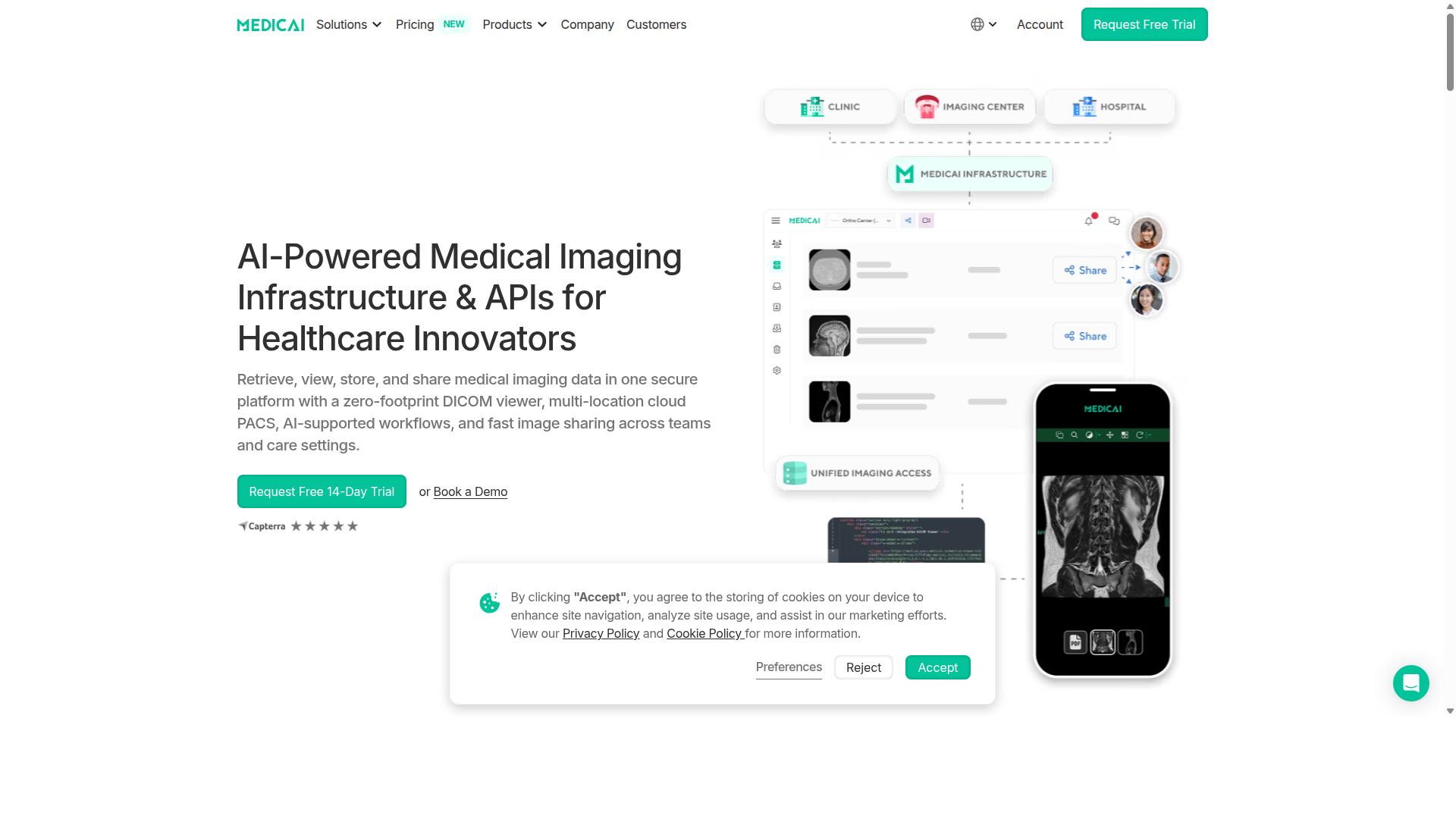
Medicai is a cloud-based medical imaging platform that unifies retrieval, viewing, storage, and sharing of DICOM studies. The platform serves as Imaging Infrastructure as a Service, delivering all functionality through a secure online environment. Healthcare providers gain access to a unified workspace that supports both local and remote imaging workflows.
The architecture centers on a zero-footprint DICOM viewer that requires no local software installation. A Vendor Neutral Archive stores studies in encrypted cloud storage, eliminating reliance on on-premise servers. This design supports multi-location cloud PACS deployments without hardware management overhead.
Medicai enables interoperability by connecting to existing radiology information systems and electronic medical records. The solution accepts standard DICOM, HL7, and FHIR data formats, allowing sites to maintain current RIS and EMR connections while moving to cloud infrastructure. Teams can share studies across care settings without physical media or manual file transfers.
The platform supports teleradiology and remote reading scenarios through secure web access. AI-supported workflows assist with study prioritization and triage, while maintaining HIPAA compliance and audit trails. User permissions and role-based access controls govern who views or shares specific studies.
Scalability comes from the cloud-native design. Additional storage, processing capacity, and user seats expand without new hardware purchases. Multi-site deployments benefit from centralized management and consistent performance across locations, regardless of physical distance between facilities.
What Is EMSOW?
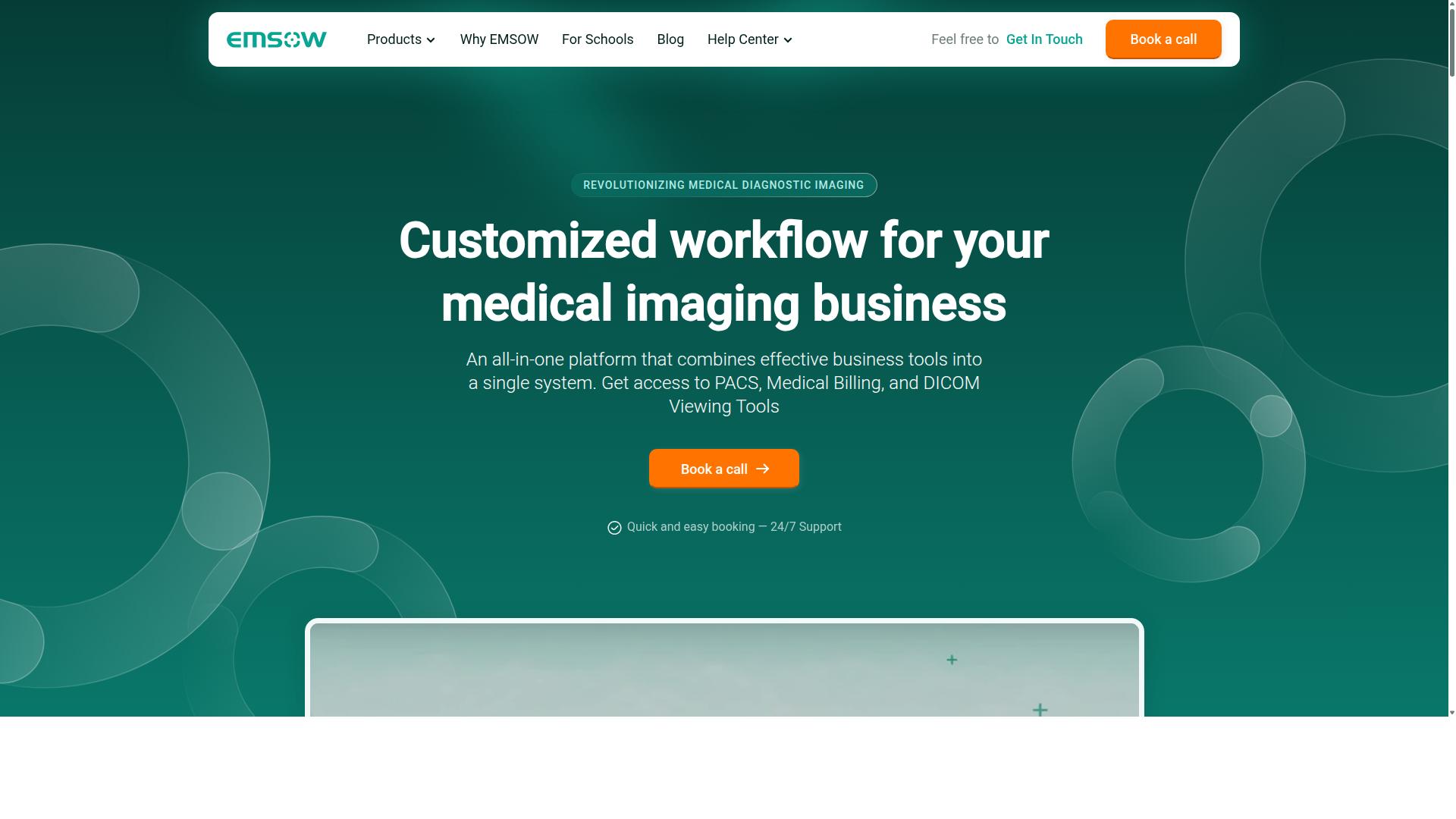
EMSOW is a legacy RIS/PACS suite that traditionally combines scheduling, order entry, and on-premise image storage. Many facilities continue to run this platform because it handles core radiology information system functions alongside picture archiving and communication capabilities.
The software typically follows an on-premise or hybrid deployment model. Some organizations choose hybrid setups that connect local servers to external readers or partner sites for teleradiology workflows.
Core functions usually include modality worklist generation through DICOM and HL7 messaging. These standards allow basic EMR integration and study routing between connected systems.
Maintenance of legacy systems often requires local IT oversight. Facilities may face challenges when scaling across multiple sites or when seeking advanced cloud PACS features that newer vendors provide.
Interoperability options remain available through standard protocols, yet organizations report varied success with modern API connectivity. Data migration efforts can prove complex when moving away from established on-premise PACS installations.
What Is Medicai for RIS/PACS Integration?
Medicai's integration layer connects existing RIS workflows to its cloud PACS using HL7, FHIR, and DICOMweb APIs. This layer enables radiology departments to maintain their current order entry and report generation systems while accessing modern cloud storage and visualization tools.
The Medical Imaging Uploader and DICOM Gateway handle connectivity between modalities and the central archive. These components receive studies from imaging equipment and route them to the cloud PACS for storage and access across multiple sites.
Study reconciliation occurs when incoming studies are matched with existing patient records and orders through the HL7 interface. The system automatically updates the modality worklist so technologists receive accurate patient information at the scanner console.
Medicai processes over 50 million API transactions each year. This scale supports continuous data flow between the radiology information system, imaging modalities, and downstream reporting applications without manual intervention.
The cloud PACS functions as a vendor neutral archive that stores DICOM objects alongside non-DICOM documents. This approach eliminates the need for separate on-premise servers while maintaining HIPAA compliance and audit trail capabilities.
Structured reporting tools connect directly to the archive so radiologists can launch cases from the Doctor Imaging Portal. AI-powered diagnostics and teleradiology features become available once studies reach the cloud environment.
Features Compared
Three core functional areas separate modern cloud PACS from legacy RIS/PACS stacks. These areas include storage architecture, access methods, and workflow intelligence. Each area affects how radiology departments handle growing imaging volumes across multiple locations.
Legacy platforms often rely on on-premise hardware with fixed capacity. Modern solutions shift these functions to scalable cloud infrastructure. The differences become clear when examining specific capabilities under each heading.
Cloud PACS Integration
Medicai's Cloud PACS accepts incoming studies via DICOM Gateway and routes them to a Vendor Neutral Archive. The system connects with existing RIS platforms through standard protocols. This approach removes the storage ceiling that typically limits on-premise EMSOW deployments.
Upload automation handles incoming modalities without manual intervention. Studies flow directly into the archive while maintaining DICOM metadata integrity. The platform currently stores 1.7M+ studies with built-in disaster recovery copies across separate geographic zones.
EMSOW installations usually depend on local servers with hardware-based limits. Adding capacity requires new equipment purchases and IT maintenance windows. Cloud storage removes these constraints while preserving interoperability with existing order entry and report generation systems.
Zero-Footprint DICOM Viewer
Medicai's zero-footprint viewer renders DICOM studies in-browser, eliminating plug-ins for remote readers. Radiologists access images from any location without installing software on their workstations. This capability supports teleradiology workflows across multiple sites and time zones.
The viewer recorded 300k+ visualizations in the past year. Studies load with sub-second latency even when accessed from distant locations. Multi-site deployments benefit from consistent performance regardless of network conditions at each location.
Traditional EMSOW viewers often require local software installation and periodic updates. Remote readers may face compatibility issues with different operating systems or security configurations. Browser-based viewing removes these variables while maintaining HIPAA compliance standards.
AI-Supported Workflows
Medicai integrates third-party AI models for automated study triage and structured report population. The platform processes 50M+ API transactions annually to connect AI outputs with both the viewer and connected RIS systems. This integration accelerates radiologist interpretation without disrupting existing workflows.
AI findings appear alongside original images in the viewer interface. Structured reports receive pre-populated fields based on AI analysis results. Radiologists maintain final review authority while gaining time savings on routine cases.
EMSOW platforms typically require separate AI implementations or manual data export processes. Integration between AI tools and the core RIS/PACS stack demands custom development work. Medicai's approach consolidates these functions through existing API connectivity rather than additional system layers.
Pricing Compared
Medicai publishes transparent monthly tiers while EMSOW pricing varies by deployment model. This difference matters when teams evaluate total cost of ownership for RIS/PACS integration. Fixed rates simplify budgeting and reduce surprises at renewal.
Starter costs $249 per month and includes 500 GB of cloud storage with unlimited user accounts and no connected locations. This tier supports small practices that need basic image access and secure sharing without multi-site complexity. It also comes with a free 14-day trial of Starter features and requires no credit card to start.
Standard costs $749 per month and provides 2 TB of cloud storage, unlimited user accounts, and one connected location. This plan fits growing organizations that require reliable interoperability with existing EMR systems and basic DICOM routing. Both tiers offer 15 percent savings when paid yearly.
Enterprise customers work directly with the vendor for custom cloud storage, multiple connected locations, and multiple external locations. Per-study pricing is available for enterprise customers. Refunds are not available for partial periods, and a one-time DICOM Gateway Setup fee of $1,000 applies per location for new connections.
Teams comparing options should contact EMSOW directly for current pricing because the vendor does not publish standard rates. This approach makes cost forecasting harder when evaluating RIS/PACS integration across different deployment models. Transparent pricing helps organizations of all sizes plan ahead without hidden fees.
Who Should Choose Medicai
Hospitals and imaging centers needing scalable, compliant cloud storage select Medicai for multi-site deployments.
Multi-specialty groups find value in a single platform that serves radiology, cardiology, neurology, and orthopedics at once. Such groups often manage separate RIS and PACS environments that struggle to communicate.
Remote reading becomes straightforward when all images sit in one accessible location. Radiologists can review studies from any workstation while maintaining full HIPAA compliance and audit trails.
Cross-facility image exchange reduces the need for physical media or repeated exams. Referring physicians across locations gain quick access to prior studies, supporting faster clinical decisions and smoother care coordination.
Specialty practices appreciate the ability to connect with existing EMR systems without major infrastructure changes. Orthopedic clinics and neurology centers can maintain their current workflows while adopting cloud-based storage that scales with volume.
Teleradiology services and virtual care providers also fit the audience. These organizations need reliable image access across geographic boundaries, and Medicai supports both internal teams and external reading partners through secure connections.
Who Should Choose EMSOW
Organizations preferring fully on-premise control or already standardized on EMSOW interfaces may retain that platform.
Some practices maintain long-standing relationships with their existing vendor. These groups often value direct server access and custom scripting capabilities that remain available only when hardware stays inside their facility.
Facilities that have already trained staff on older radiology information system layouts may find switching disruptive. Staff familiarity with established order entry screens and report generation templates can outweigh potential gains from newer architectures.
Multi-site deployments that rely on legacy modality worklist configurations sometimes retain their current setup to avoid reconfiguring each imaging device. This approach reduces immediate downtime but limits future scalability options.
Teams that handle sensitive data locally and meet strict internal policies may keep on-premise PACS solutions. Control over physical servers supports certain audit trail requirements without involving external hosting providers.
Research suggests that organizations with these priorities often remain with entrenched platforms despite broader industry movement toward cloud PACS and vendor neutral archive strategies.
Who Should Choose Medicai for RIS/PACS Integration
Health systems replacing multiple legacy archives or expanding teleradiology services choose Medicai for seamless RIS/PACS integration.
Organizations that rely on existing radiology information systems can connect through HL7 or FHIR standards. This approach moves imaging studies into a single cloud VNA without hardware refreshes or major infrastructure changes.
Vendor neutral archive capabilities allow hospitals to consolidate studies from different modalities and locations. The Cloud PACS stores and manages data centrally while maintaining compatibility with current workflows.
Facilities that need both local and remote reading benefit from the Medical Image Exchange and Doctor Imaging Portal. These tools support teleradiology operations across multiple sites without requiring new hardware investments.
Multi-site deployments often struggle with fragmented archives and inconsistent access methods. Medicai addresses this by providing a unified platform that connects to existing systems while offering scalable storage and retrieval options.
Teams that perform tumor boards or need structured reporting can use the available tools for collaboration. The platform supports these workflows through its existing features rather than requiring separate solutions.
Organizations evaluating EMSOW versus Medicai should consider their current archive situation. Systems with multiple legacy PACS vendors or plans for teleradiology expansion often find the cloud VNA approach reduces maintenance overhead compared to maintaining separate on-premise systems.
Final Verdict
Medicai offers a modern, API-first cloud PACS that outperforms legacy on-prem stacks in scalability and compliance. The platform handles more than one million studies each year while maintaining full DICOM, HL7, and FHIR interoperability.
Its zero-footprint viewer removes local installation requirements, which simplifies deployment across multiple sites and supports remote reading for teleradiology workflows. Over fifty million API calls processed to date confirm stable connectivity for EMR integration and order entry tasks.
EMSOW remains a traditional on-premise solution that can require more maintenance and infrastructure planning. Healthcare teams evaluating RIS/PACS integration often find that cloud-native architecture reduces long-term operating costs and speeds up multi-site deployment.
Organizations selecting an imaging platform should weigh current infrastructure, expected growth, and compliance needs. Medicai provides the contact details below for a tailored demonstration that matches specific workflow requirements.
Medicai USA, 7901 4th St N, STE 300, St. Petersburg, FL, 33702, Phone +1 (832) 220 1035. Medicai Romania, 53-55 N Filipescu, 5th Floor, Sector 2, Bucharest, 020961, Phone +40 316 305 875. Email [email protected].
Recommended Resources: